
Integrated Algebra II - Coach Hill's Blog for information pertaining to his 2010 Alg II classes!
Monday, October 3, 2011

Thursday, August 25, 2011

Tuesday, April 12, 2011
Wednesday, March 30, 2011
Special Situations in Factoring
- Difference of two squares
- a2- b2 = (a + b)(a - b)
- x2- 144 = (x + 12)(a - 12)
- x2- 144 = (x + 12)(a - 12)
- x2- 144 = (x + 12)(a - 12)
- Trinomial perfect squares
- a2 + 2ab + b2 = (a + b)(a + b) or (a + b)2
- 3 examples
- a2 - 2ab + b2 = (a - b)(a - b) or (a - b)2
- 3 examples
- Difference of two cubes
- a3 - b3
- 3 - cube root 'em
- 2 - square 'em
- 1 - multiply and change
- 3 examples
- Sum of two cubes
- a3 + b3
- 3 - cube root 'em
- 2 - square 'em
- 1 - multiply and change
- 3 examples
- Binomial expansion
- (a + b)3 = Use the pattern
- (a + b)4 = Use the pattern
Friday, December 10, 2010
Friday, December 3, 2010


Tuesday, November 30, 2010
Performance Exam Review
Found some good links on Itunes
Systems of Equations click on the link and download the handouts and follow along on the MP3's!
Don't forget to use your review and go to Bright Storm!
Email me or chat at rthill3@gmail.com
Systems of Equations click on the link and download the handouts and follow along on the MP3's!
Don't forget to use your review and go to Bright Storm!
Email me or chat at rthill3@gmail.com
Friday, November 19, 2010

Thursday, November 18, 2010
Wednesday, November 17, 2010
Identifying special situations in factoring
- Difference of two squares
- a2- b2 = (a + b)(a - b)
- 3 examples
- Trinomial perfect squares
- a2 + 2ab + b2= (a + b)(a + b) or (a + b)2
- 3 examples
- a2 - 2ab + b2 = (a - b)(a - b) or (a - b)2
- 3 examples
- Difference of two cubes
- a3 - b3
- 3 - cube root 'em
- 2 - square 'em
- 1 - multiply and change
- 3 examples
- Sum of two cubes
- a3 + b3
- 3 - cube root 'em
- 2 - square 'em
- 1 - multiply and change
- 3 examples
- Binomial expansion
- (a + b)3 = Use the pattern
- (a + b)4 = Use the pattern
Tuesday, November 9, 2010
End Behaviors
Domain - x values
Range - y values referred to as f(x)

- domain → +∞, range → +∞ (rises on the right)
- domain → -∞, range → -∞ (falls on the left)

- domain → -∞, range → +∞ (rises on the left)
- domain → +∞, range → -∞ (falls on the right)

- domain → +∞, range → +∞ (rises on the right)
- domain → -∞, range → -∞ (falls on the left)

- domain → +∞, range → -∞ (falls on the right)
- domain → -∞, range → -∞ (falls on the left)
Monday, October 4, 2010
INT Algebra2-Lennart Galdiga: Quadratic Functions
Click on the link below and you will see EXACTLY what you need to do for this blog. If he could find a image or two of the graphing of each of the equations....IT WOULD BE PERFECT!
INT Algebra2-Lennart Galdiga: Quadratic Functions: "How to identify quadratic functions: Standardform: ax² + bx + cy² + dy + e= 0 If you have an equation like 4x² + 4y²=36 The equation is a ..."
Friday, October 1, 2010
Multipying Matrices
This is as good as you can do! AWESOME!!!
Multipying Matrices: "Scalar multiplication is when you distribute the number outside the matrix to all the numbers inside the brackets.

For example:

2 x 2 2 x 2
2 x 2 times 2 x 2
The numbers highlighted show that the matrices can be multiplied, since the inside numbers are the same.
2 x 2 times 2 x 2
These numbers become the dimensions for the product matrix.
After you determined that the matrices can be multiplied, then you start to multiply them together. To do this, you would multiply the first row of the first matrix with the column of the second matrix. More specifically, you would multiply the first number of the first row on the first matrix with the first number of the first column of the second matrix. You then add the products together and thats the first number of the product matrix. You repeat this until all the numbers of both the matrices have been multiplied, giving you your product matrix.

Wednesday, September 29, 2010
Monday, September 27, 2010
Muliplying Matrices
Here Jordan Bayne explains the concept of dimension statement. I can really see he knows what is going on! Really nice!!!
[3 4] [1 2 3]
[5 6] [4 5 6]
[7 8]
The dimension statement for this would be 3X2 times 2X3.
- The numbers on the inside (in red) must be the same to carryout the multiplication process
- The numbers on the outside (in blue) tell what the dimension of the solution will be. In this particular problem, the solution will be a 3 X 3 matrix.

Tuesday, September 21, 2010
Int Algebra II - Erin Johnson: Can you multiply Matrices?
Good example of what I am looking for...click on the link!
INT ALG II - Alex Nguyen: Multiplying Matrices
To see what muliplying matrices are about...
INT ALG II - Alex Nguyen: Multiplying Matrices: "Scalar matrix multiplications Distribute the outside number for all the numbers on the inside. When multiplying matrices. We must note..."
INT ALG II - Alex Nguyen: Multiplying Matrices: "Scalar matrix multiplications Distribute the outside number for all the numbers on the inside. When multiplying matrices. We must note..."
Dimensions of a Matrix
Here is a good one from Alex Reid!!!
Dimensions of a Matrix: "The dimensions of a matrix refer to the number of rows and number columns of a given matrix.
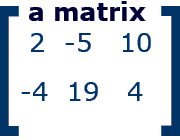
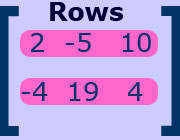
The rows of a matrix are the numbers going horizontally.
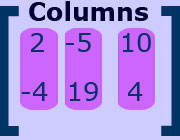
The columns of a matrix are the numbers going vertically.
To find the dimensions of a matrix you must multiply the (number of rows x the number of columns). The dimensions for the matrix above would be (2 rows x 3 columns). The dimension of the matrix is 2 by 3 or (2x3).
Thursday, September 16, 2010
Dimensions of a Matrix
This looks like a good start! However, this student needs to add something about the square matrices and the matrix that is the identity matrix. These are important concepts that you need to be able to identify!
Dimensions of a Matrix: "To count matrices you count row X column
 This matrix is one row by three columns, so it is a 1 x 3 matrix.

This matrix is three rows by three columns, so this is a 3 x 3 matrix.
 This matrix is three rows by two columns, so it is a 3 x 2 matrix.
 This is another three rows by three columns, so this is a 3 x 3 matrix.
 "
"
Dimensions of a Matrix: "To count matrices you count row X column


This matrix is three rows by three columns, so this is a 3 x 3 matrix.


Subscribe to:
Posts (Atom)